
Double Eyelid Surgery
$4,950
The procedure fee includes the surgical component and standard postoperative care. There is no additional costs.
The consultation fee is $250. Attendance at a consultation does not create any obligation to proceed with surgery. The consultation fee will be reimbursed if you proceed with surgery within three months of the consultation.
• Australian-trained medical practitioner with postgraduate training in cosmetic surgery
• Extensive experience in blepharoplasty procedures
• Focused clinical practice in cosmetic eyelid surgery
Fees and treatment options are discussed transparently during consultation.
Double Eyelid Surgery Sydney Dr Peter Kim
This page provides general information about double eyelid surgery, which refers to procedures that may be used to create or refine an upper eyelid crease in suitable patients. Individual suitability and outcomes vary and are assessed during consultation. This page is about creating double eyelids in younger Asians. For mature Asians, please see our page on Asian blepharoplasty.
About Dr Peter Kim and the Practice
Dr Peter Kim is a registered medical practitioner with postgraduate training in cosmetic surgery and more than 20 years’ experience in cosmetic eyelid procedures, including Asian eyelid surgery. His clinical practice includes both surgical and non-surgical eyelid techniques. He has authored and co-authored peer-reviewed publications relating to eyelid procedures and practises in accordance with professional and regulatory standards.
The clinic focuses primarily on blepharoplasty and related eyelid procedures. Treatment options, suitability, risks, and limitations are discussed during consultation.
Purpose of Double Eyelid Surgery
Double eyelid surgery aims to create or enhance an upper eyelid crease where one is absent or poorly defined. The goal is to modify eyelid contour and crease definition based on individual anatomy and preferences.
Not all patients are suitable for this procedure, and outcomes vary.
Monolid and Double Eyelid Anatomy
A monolid refers to an eyelid without a visible upper lid crease. A double eyelid refers to the presence of a defined upper eyelid crease. The difference is anatomical and varies naturally between individuals.
Images are provided for educational purposes only and do not guarantee outcomes.


The photo on the left shows a monolid, while the image on the right displays a double eyelid. The key difference is the presence of an upper lid crease, which defines the “double eyelid.”
This crease creates a more open, defined eye appearance and is highly sought after by many in the Asian community.
Techniques That May Be Considered for Younger Patients
Two approaches may be considered depending on anatomy, skin thickness, fat distribution, and patient goals.
Non-Surgical Thread Technique
In selected patients, an upper eyelid crease may be created using a thread-based technique. This method does not involve skin incision. Suitability and durability vary between individuals.
Indicative fee: $3,450, no extra cost.
Surgical Incision Technique
In some patients, a small surgical incision may be used to create or refine an upper eyelid crease. This approach may involve removal or repositioning of tissue where clinically indicated.
Indicative fee: $4,950, no extra cost.
Not all patients are suitable for non-surgical techniques. The most appropriate method is determined during consultation.
Fees and inclusions are discussed clearly prior to any procedure. Some patients may wish to have epicanthoplasty to widen the eyes and added costs apply.


Clinical Publications
Dr Kim has published peer-reviewed articles relating to eyelid procedures, including techniques relevant to double eyelid surgery. Publications may be discussed during consultation where relevant.
Eyelid Shape Selection
There are several commonly described eyelid crease configurations. Selection depends on individual anatomy, facial proportions, and personal preference.

Which Option Is Suitable for Me?
Suitability for any procedure depends on individual clinical factors. During consultation, Dr Kim will assess eyelid anatomy, discuss realistic expectations, explain available options, and outline potential risks and limitations.
Visual demonstrations may be used to explain possible changes. These are illustrative only and do not guarantee outcomes.
Further Information
Please refer to the tabs below for detailed information about each procedure, including preparation, recovery, risks, and aftercare.
Clinical Examples
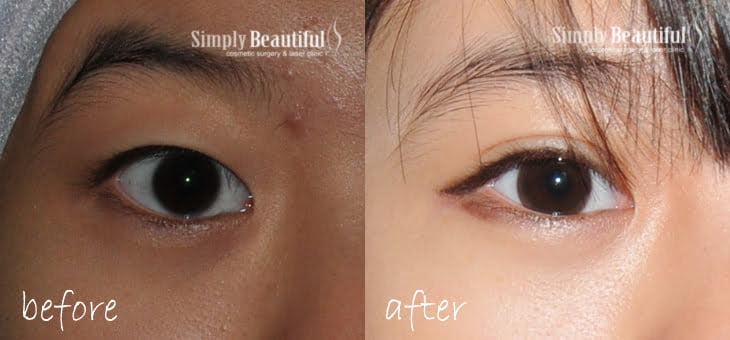
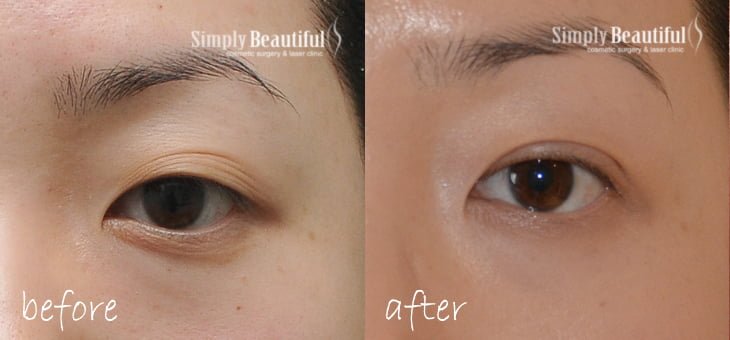
Images may show examples of patients who have undergone non-surgical or surgical double eyelid procedures. These images are provided for informational purposes only. Individual healing and results vary.
Which double eyelid procedure is best for me?
It all depends on what is your current eyelid shape and what eyelid shape you desire.
The choice of the technique used depends on your current eyelid shape and the desired eyelid shape. We work backwards from your desired eyelid shape and plan to create your desired eyelid shape from your current eyelids.
You can choose the shape of double eyelids you wish for
These four types of eyelid shapes can be created/reshaped by altering the eyelid anatomy below.

Depending on what shape you would like to have, one more more of the following procedures may be needed to create, reshape or lift the double eyelids.
- Full incision v Partial incision v Non-incision (non surgical)
- Levator Lifting
- Mongolian fold Surgery (epicanthoplasty)
- Sub-Brow lifting
These procedures are generally done under local anaesthesia in doctor’s procedure room.
They are not covered by Medicare or private insurance.
More information on each of the procedures are listed below.












This is the paper that was published in the American Journal of Cosmetic Surgery on Durable Suture technique – non surgical double eyelid plasty – by Dr Peter Kim. He has presented his 15 years of experience in DST.


This is the paper published in the Australasian Journal of Cosmetic Surgery on Dr Peter Kim’s epicanthoplasty technique in 2010. Dr Kim has used the same technque since 2010 and they are still relevant in epicanthoplasty in 2023.


 This patient had one half of eyelid affected by ptosis.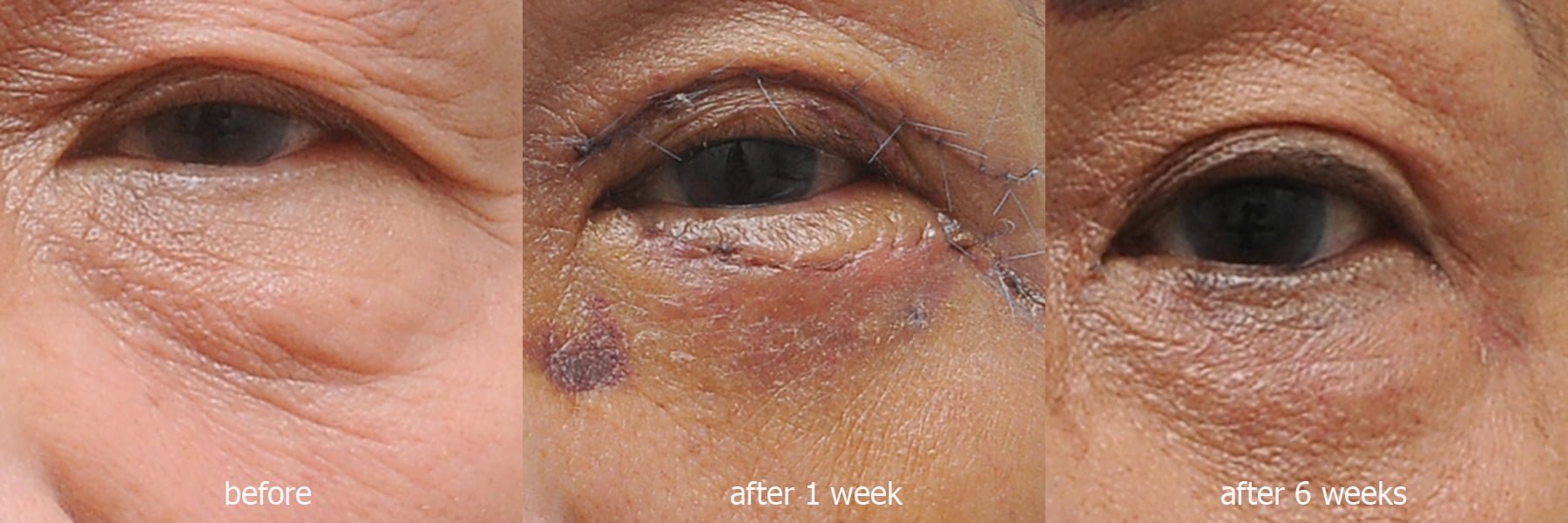

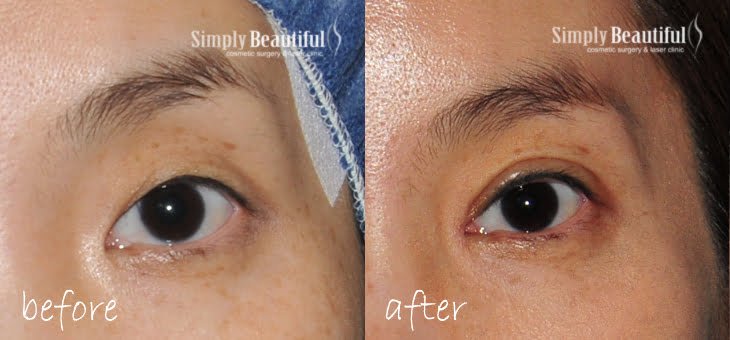
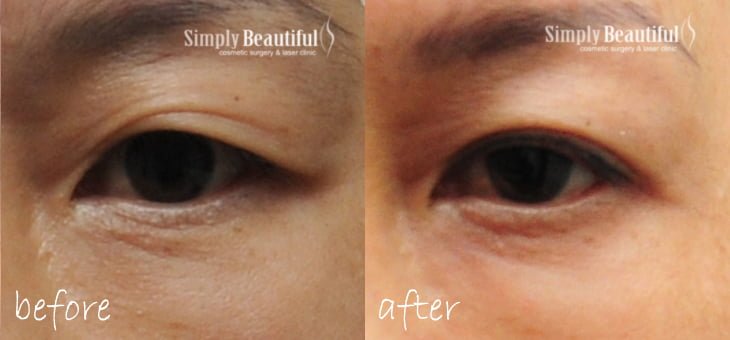
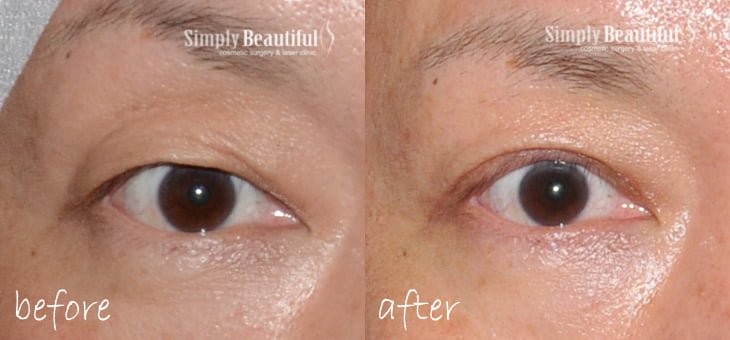
This patient had Asian upper blepharoplasty lift surgery.
 This patient had Asian upper blepharoplasty lift surgery.

This patient had upper blepharoplasty lift surgery.
This patient had Asian upper blepharoplasty lift surgery.

This patient had non surgical double eyelid stitch called the durable suture technique. Results are before, 1 week, 6 weeks and 3mths.

There are a number of complications that are generally associated with all surgeries, and some specific to upper blepharoplasty. Most complications are temporary and heal spontaneously.
Some of the things that could go wrong are:
- scarring is unavoidable (we place the scar in the crease to make it less perceptible)
- pain (usually paracetamol is sufficient),
- prolonged swelling lasting for months and in rare event upto a year,
- bleeding after discharge (need to return to the clinic to stop the bleed),
- assymetry (10% normal) requiring correction,
- abnormal scars (requiring scar injections and other corrections),
- blurred vision (usually few days due to swelling),
- dry eyes (need some lubricating eyedrops),
- over and under correction (careful planning to avoid this),
- not meeting patient’s expectations,
- infection (we routinely give antibiotics),
- allergic reaction,
- double eyelids gets undone,
- We are not aware of any cases of blindness and death from blepharoplasties performed under local anaesthesia as these complications are usually related to the general anaesthesia. Under general anaesthesia, these complications were reported.
Dr Peter Kim has published numerous papers on the topic of Asian Double Eyelid Surgery and blepharoplasty.
Ahn JT, Sang-Hui Kim P. Combined Sub-Brow Lift and Upper Blepharoplasty to Minimize the Supratarsal Fold Thickness and Lateral Hooding: A Concept and Review of Cases. The American Journal of Cosmetic Surgery. July 2022.
-
Abstract
Despite upper blepharoplasty being the most popular periorbital rejuvenation surgical procedure, in Asians with moderate to severe blepharochalasis, the occurrence of postoperative puffy supratarsal fold (double eyelid) and residual lateral hooding is not uncommon. A qualitative retrospective analysis of before and after photos of 268 cases of combined sub-brow lift and upper blepharoplasty was done. A substantial number of cases had satisfying supratarsal fold thickness and improvement in lateral hooding. A combined sub-brow lift and upper blepharoplasty is an effective method to reduce the supratarsal fold thickness and lateral hooding in Asians with moderate to severe blepharochalasis.
Durable Suture Technique: A Simple and Versatile Nonsurgical Technique to Create/Reshape Double Eyelid in Asians. The American Journal of Cosmetic Surgery. Jan 2023.
- Abstract
Nonincisional double-eyelid plasty, the Durable Suture Technique, is a popular nonsurgical procedure for creating double eyelids on monolids. We report cases where the Durable Suture Technique was successfully applied to other Asian cosmetic eyelid indications. A series of before-and-after photos of patients who underwent the Durable Suture Technique were shown to demonstrate that it is effective in reshaping and rejuvenating the double eyelids, as well as treating post-blepharoplasty complications. The rationale for applying the Durable Suture Technique in the above nonstandard indications was discussed. The Durable Suture Technique is a versatile, nonsurgical cosmetic eyelid enhancement procedure in Asians.
T epicanthoplasty: New Surgical Treatment of Asian Mongolian Fold. Journal of Cosmetic Surgery & Medicine. 2010; 5 (1):58-62.
- Abstract:
Epicanthal fold (Mongolian Fold) is a unique feature of the Asian eye. It is present in the majority of Asians and is frequently and culturally seen as being aesthetically displeasing. There are numerous epicanthoplasty techniques reported in the literature that have been shown to be effective. However, they are technically difficult, complex in design, and not simple to learn. T-epicanthoplasty is a surgical approach to correct Mongolian folds using transposition micro-flap surgery for the epicanthal fold. It is simple to learn and offers an effective solution to the treatment of this common Asian cosmetic concern.
As per Good Medical Practice Guideline, we would like to notify you that:
-
Any surgical, invasive, nonsurgical, or laser procedure carries risks.
-
Complications do and can occur.
-
Previous success is not a promissory indication of future success.
-
Before proceeding, you should seek a second opinion from an appropriately qualified health practitioner.
-
All before and after photos on this site are Dr Peter Kim’s work.
-
Copyrights reserved by Dr Peter Kim.
The next step
If you have any questions or concerns about double eyelid surgery, please feel free to contact us. Dr Kim has helped hundreds of patients achieve their desired results. We would be happy to discuss the procedure with you in more detail and answer any questions you may have. To book an appointment, call 9411 4880.
Mandatory two consultations are required before the surgery, a cooling off period, Body Dysmorphic Disorder Assessment and a referral from your GP.
General information about blepharoplasty can be found on this webpage. During the consultation, our doctor will provide you with specific advice after reviewing your case. This is why the consultation is important.
For your convenience, Dr Kim consults at Chatswood, Eastwood and Cabramatta.